Perforated Filter Disc — Durable, Customizable Metal Filter Discs
What Is a Perforated Filter Disc? — Definition, Design & Industrial Uses
Perforated filter discs are metal filter elements produced by precision perforation or stamping of metal sheets, then finished and formed to meet application-specific filtration and mechanical requirements. They combine high strength and temperature resistance with predictable flow and open area characteristics — ideal for coarse to medium filtration in industrial processes. Typical materials include stainless steels (SS304/316), aluminum, copper, brass and plated steels.
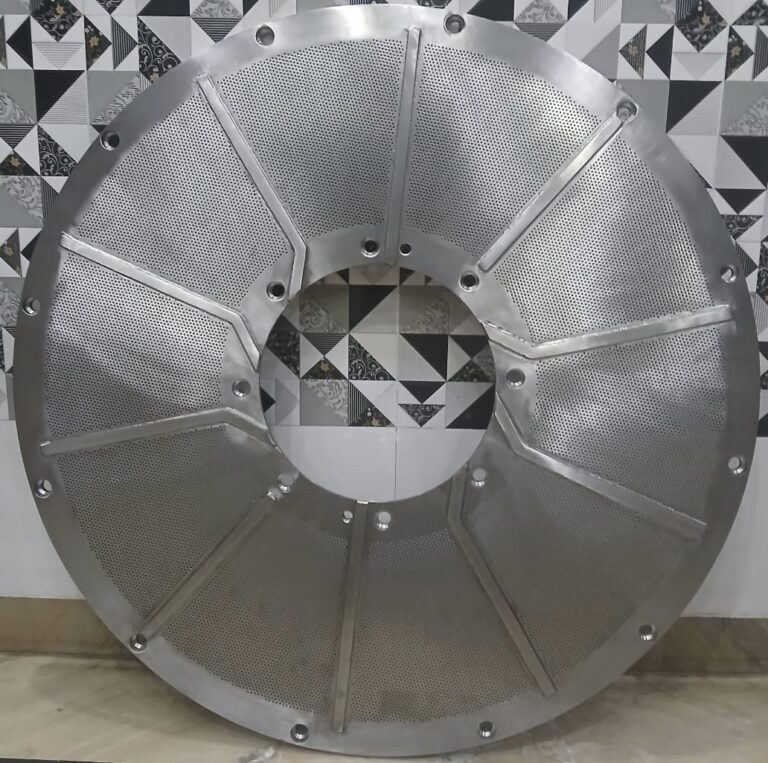
Why choose our Perforated Filter Discs?
- High mechanical strength: manufactured from wrought metals and suitable for pressurized systems.
- Custom hole patterns: round, square, hexagonal or slotted holes to control open area and flow.
- Wide material selection: SS304, SS316/316L, aluminum, copper, brass and specialty alloys.
- Fast delivery & OEM volumes: prototype to high-volume stamping or laser production.
Technical Specification
| Parameter | Typical Range / Options |
|---|---|
| Materials | SS304, SS316 / SS316L, Aluminum, Copper, Brass, Low-carbon steel. |
| Disc diameter | 5 mm — 600 mm (custom sizes beyond this on request) |
| Thickness | 0.15 mm — 12 mm (commonly 0.3–2.5 mm for thin discs). |
| Hole diameter | 0.5 mm — 10 mm (or larger slotted/rectangular openings). |
| Hole patterns | Round, square, hexagonal, slotted; staggered/inline pitch options. |
| Filtration precision | Coarse to medium (approx. 2 μm up to 1000 μm depending on construction — sintered discs for sub-micron). |
| Finish | Deburred, passivated (for stainless), polished, electroplated (if required). |
| Edge options | Plain, margin/flange, wrapped edge or rubber bonded seal. |
Manufacturing Methods & Quality Controls
Perforation / stamping: Rapid, repeatable hole patterns; ideal for robust discs and high volumes.
Laser/chemical etch: For complex or tight-tolerance patterns and smaller runs.
Sintering / powder metallurgy: Produces porous discs with controlled micron ratings for fine filtration (used when sub-micron retention is required).
Finishing & inspection: Deburring, dimensional inspection, hole geometry QA and optional passivation or coating for corrosion resistance.
Typical Applications
- Oil & gas separation and coarse filtration.
- Chemical & petrochemical process filtration.
- Food & beverage pre-filtration (frames and housings to food-grade finishes).
- Laboratory frit supports, filter holders and analytical setups.
- Hydraulic and lubrication system strainers, spray nozzle screens, and coffee machine shower screens.
How to specify your perforated filter disc (quick checklist)
- Material (SS304, SS316L, copper, brass, etc.)
- Disc outer diameter (OD) and inner diameter (ID) if ring.
- Thickness (mm).
- Hole shape, hole diameter and pitch (or desired open area %).
- Tolerance & finish requirements (passivation, polished, deburred).
- Edge type (flange, margin, wrapped edge, bonded rubber).
- Operating conditions (pressure, temperature, media chemical compatibility).
Providing these details shortens lead time and reduces engineering cycles.